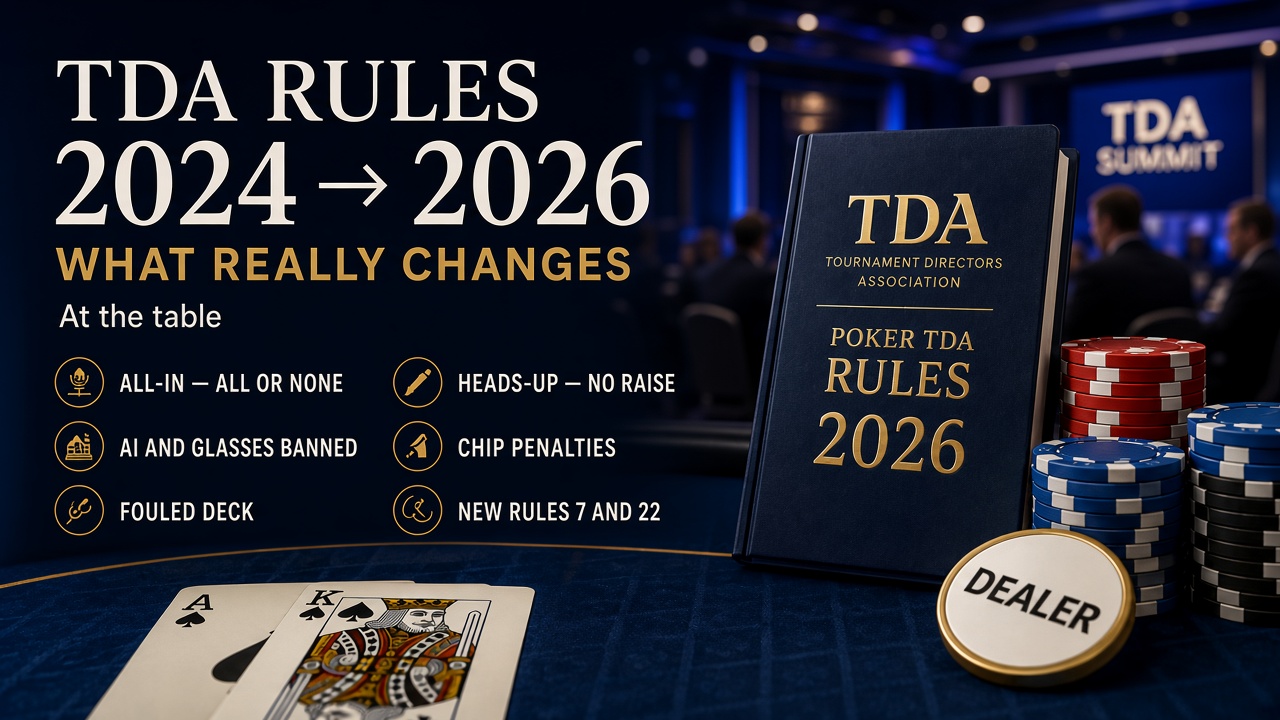
TDA 2024 → 2026: What Really Changes at the Table
Numbering: “2024 → 2026.” Rules 1–6 keep their number, 2024 rules 7–20 shift by +1, and from 2024 rule 21 onward by +2, because rules 7 and 22 are new in 2026.The 2026 version of the Tournament Directors Association (TDA) Rules does not upend tournament poker. The fundamentals remain the same: cards speak, string bets are prohibited, substantial action, and the amount of a raise. But several additions change concrete floor decisions. This article ignores minor changes and focuses on what affects the flow of play or rulings.
1. Changes that affect play and rulings
All-in: all chips or none (RP1)
Recommended Procedure RP1 was called “All-In Buttons” in 2024. In 2026 it becomes “All-In Betting and Plaques,” and its scope expands.
- 2024: RP1 was limited to the all-in marker: the dealer keeps it and places it in front of the player, clearly visible to the table.
- 2026: the same principle applies to the plaque (the term “plaque” replaces “button”), but with a new instruction: “When betting all-in, either all or none of the player's chips should be clearly pushed forward.”
- Rationale for the text: a partially pushed-forward stack, with chips left behind, can mislead the other players.
Heads-up: an out-of-turn check prevents a later raise
Rule 53 → 55, Action Out of Turn.- 2024: an out-of-turn action is returned to the correct player, and it is not binding if the action changes in the meantime.
- 2026: heads-up, if Player B acts passively out of turn (checks), they may only call or fold facing a bet by A. They may not raise.
- This prevents using a premature check to test the opponent before raising.
Technology: smart glasses, hidden cameras, and AI agents
Rule 5 (number unchanged).- 2024: a player with a live hand may not use an electronic or communication device.
- 2026: wearable devices (smart glasses, hidden cameras) and any recording, communication, or outside assistance technology, including AI agents, are prohibited at the table unless authorized by the TD.
Conduct: three rules instead of one, plus chip penalties
Rules 70–71 → 72, 73, 74 and RP26.- Rule 72, conduct: abusive behavior, harassment, and game integrity.
- Rule 73, pace and mechanics: intentional or repeated slowing of play, and physical etiquette.
- Rule 74, warnings, penalties, and disqualification: carries forward the former Rule 71.
- RP26, Chip Penalties: the player loses chips instead of missing a number of hands or a period of time. This is an additional tool at the TD’s discretion.
- The rule concerning checking the nuts on the river (Rule 71 → 74) is still not automatic soft play. The 2026 version adds that the TD evaluates the situation.
A question can count as a declaration
Rule 3 (number unchanged).In 2026, using an action term in a question may be ruled binding. The text’s example, “did he raise,” may be interpreted as a declaration of a raise. Ask “what was his action?” instead.
Non-standard card: Fouled Decks
Rule 35 → 37, Misdeals and Fouled Decks.- 2024: a non-standard card found before substantial action was one of the cases covered by a misdeal.
- 2026: it falls within the definition of a fouled deck, along with duplicates. Play stops and wagers are returned, regardless of substantial action.
Showdown: keep losing hands identifiable
Rule 12 → 13, Declarations. Cards Speak, and Rule 15, Live Cards at Showdown.- Rule 13: verbal declarations of action (“fold,” “you win,” “take it”) are not binding at showdown, in addition to declarations of hand value.
- 2026 addition: an exposed losing hand must be turned face down but remain identifiable until the winner is determined and the pot is awarded.
Stud, 7th street: a card exposed by the dealer
RP10 (number unchanged).If a down card on 7th street is exposed by the dealer, it is replaced as long as there is betting remaining. The exposed card is shuffled into the stub. In 2026, the player may not keep it by declaring all-in.
2. Tournament management
- Rule 7 (new): a player is in the tournament as soon as they have chips. Players who are not yet seated must immediately join their table.
- Rule 22 (new), BBA: order of finish and bounty prizes: if two or more players are eliminated together in the money, the player who had the larger stack after ante payment finishes ahead. The same criterion applies to bounties. BBA already existed in 2024 (RP11), but this tiebreaker did not.
- Rule 10 → 11, new players and players from broken tables: placement is possible in any seat except between the small blind and the button. The principle is unchanged, but the rule now explicitly covers both cases.
- Rules 32 and 34 → 34 and 36, dead button and button movement: the button does not belong to a seat. If there are multiple vacant seats, it may move forward several seats to preserve normal progression and placement of new players.
- Rule 20 → 21, odd chip: in non-standard and non-high-low games, it goes to the worst position.
- Rule 25 → 27, chip stacks: clean stacks of 20 chips of the same value move from recommendation to requirement.
3. New Recommended Procedures (RP23–RP29)
All of them are new: the series ended at RP22 in 2024.
- RP23, chips of an absent player: if the player is in the money or can still reach it, their chips remain in play until elimination.
- RP24, players requesting information: the floor may give the applicable rule, without strategic advice.
- RP25, draw: dealing procedure for draw games.
- RP26, Chip Penalties: see above.
- RP27, dealmaking: the house provides reasonable assistance and supervision.
- RP28, timekeeping: the first action may have less time available.
- RP29, showing cards on livestream: the house may require cards to be shown.
Conclusion
The 2026 TDA Rules rest on three ideas. They protect the integrity of the game (AI, smart glasses, conduct, chip penalties). They close verbal and procedural loopholes (clear all-ins, heads-up out-of-turn action, binding questions, fouled decks, identifiable losing hands). They clarify tournament mechanics (Rules 7 and 22, the button, RP23–RP29).